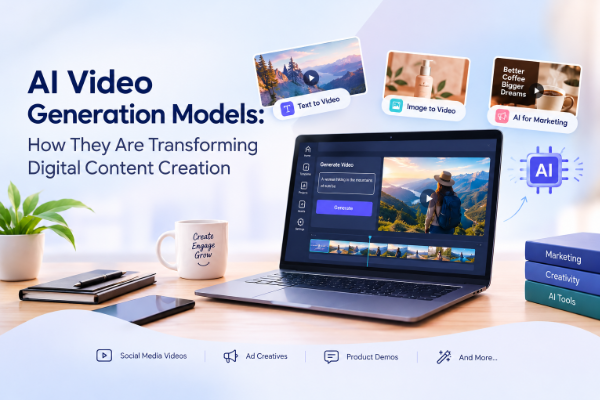
Video has become an essential part of digital marketing, social media, and online communication. From Instagram Reels and YouTube Shorts to product advertisements and promotional campaigns, businesses are constantly looking for ways to create engaging videos without spending excessive time or money. This is where AI video generation models are making a difference.
These models use artificial intelligence to transform text prompts, images, scripts, and other inputs into video content. As the technology evolves, creators and businesses can produce videos more efficiently while exploring new ways to communicate their ideas.
What Are AI Video Generation Models?
AI video generation models are systems designed to create or modify video content using artificial intelligence. Depending on the model, users can generate video clips from written descriptions, animate still images, create realistic scenes, or turn existing content into new visual formats.
Many of these systems use deep learning techniques to understand prompts, interpret visual information, and generate sequences of frames that form a video. Some models focus on realistic motion and cinematic visuals, while others are designed for marketing content, animated explainers, and social media videos.
The growing range of capabilities means that AI video generation is no longer limited to experimental projects. It is becoming a practical option for businesses, marketers, educators, and independent creators.
Popular Types of AI Video Generation Models
- Text-to-Video Models
Text-to-video models generate video clips from written prompts. Users describe a scene, action, or concept, and the model produces visuals based on that description.
These models can be useful for creating concept videos, storytelling sequences, promotional visuals, and short clips for social media. The quality of the output depends on the model, the prompt, and the complexity of the requested scene.
- Image-to-Video Models
Image-to-video models animate existing images to create movement. For example, a product photograph can become a short promotional clip, or a landscape image can be transformed into a moving scene.
This approach is particularly useful for businesses that already have product photography or branded visuals and want to repurpose those assets into video content.
- AI Models for Marketing and Advertising Videos
Marketing-focused AI video tools help businesses create content for product promotions, social media campaigns, and digital advertisements. Rather than focusing exclusively on cinematic video generation, these tools may offer features such as templates, product visuals, automated scripting, and platform-specific formats.
For teams that need to produce content regularly, these capabilities can help simplify the process of turning marketing ideas into ready-to-publish videos.
How Businesses Can Use AI Video Generation
AI-generated videos can support several business activities.
– Social media marketing: Create short-form videos for platforms such as Instagram, TikTok, and YouTube.
– Product promotion: Turn product images, descriptions, and features into engaging visual content.
– Digital advertising: Develop different creative variations to test messaging and visual approaches.
– Educational content: Explain complex topics through short visual demonstrations and animated sequences.
– Content repurposing: Adapt existing marketing materials into video formats for different platforms.
The main advantage is flexibility. Businesses can experiment with different formats and concepts without having to produce every video through a traditional filming process.
The Role of AI-Powered Tools in Video Creation
Choosing the right tool depends on the type of video a business wants to create. Some AI models are designed primarily to generate visual scenes, while AI-powered content creation platforms focus on helping users turn ideas into social media posts, videos, and advertisements.
These platforms can simplify several stages of the content creation process, from developing initial concepts to preparing promotional creatives for different social media channels.
Tools like Predis.ai help businesses create AI-assisted social media content, videos, and advertising creatives from their ideas, making it easier to plan and produce content for marketing campaigns.
For example, a small business launching a new product could use AI-assisted tools to develop video concepts, create promotional content, and prepare complementary social media posts.
An integrated workflow can also help marketing teams maintain a consistent visual identity across campaigns while reducing repetitive production tasks. However, the final content should still be reviewed to ensure that it reflects the brand’s messaging, audience, and campaign objectives.
Benefits and Limitations of AI Video Generation
AI video generation offers several advantages, including faster content production, greater creative flexibility, and the ability to experiment with multiple concepts. It can also make video creation more accessible to small businesses that do not have dedicated production teams.
However, the technology still has limitations. Generated videos may contain visual inconsistencies, unnatural movement, or inaccurate details. Some models also impose restrictions on clip length, resolution, or usage. Human review remains important to ensure that the final content is accurate, on-brand, and suitable for its intended audience.
Businesses should also consider commercial usage rights, privacy, and copyright implications before publishing AI-generated material.
How to Choose the Right AI Video Generation Tool
Before selecting a tool, consider the following factors:
- Purpose: Decide whether you need realistic generated scenes, animated images, social media videos, or advertisements.
- Ease of use: Look for a workflow that matches your team’s technical skills and production needs.
- Customization: Check whether you can control visuals, branding, captions, and video formats.
- Cost: Compare free allowances, subscription plans, and usage limits.
- Output quality: Test the results with prompts and assets similar to your actual projects.
- Publishing workflow: Consider how easily you can edit, adapt, and distribute the finished content.
The best choice is not necessarily the model with the most advanced features. It is the tool that fits your content goals, budget, and workflow.
Infrastructure and Hosting Considerations
For businesses managing larger volumes of AI-generated video content, the underlying infrastructure can also become an important consideration. Depending on the workflow, VPS hosting can provide a flexible environment for running content-related applications and managing resources, while dedicated server hosting may be suitable for teams that require greater control and consistent resources for demanding workloads. These considerations are particularly relevant when businesses are building customized AI video workflows rather than relying entirely on cloud-based platforms.
Final Thoughts
AI video generation models are changing how people create and distribute digital content. From text-to-video systems that generate new scenes to marketing platforms that simplify promotional video production, these technologies offer different solutions for different needs.
As the technology continues to develop, businesses can benefit from combining AI-generated visuals with thoughtful storytelling, brand consistency, and human creativity. Selecting tools that fit existing workflows can help teams produce engaging videos more efficiently while maintaining control over the quality and direction of their content.
Ultimately, successful AI-powered video creation depends on choosing the right technology for the job and using it to produce content that serves a clear purpose.
 Cheap Dedicated Server in India (2026): Plans, Prices & Provider Reviews
Leave a Comment